The History of the Infinity Symbol: From the Ouroboros to ∞
The ∞ is only about 370 years old — but the human hunger for the endless is ancient. Here is the real story of the symbol, from a snake eating its tail to a mathematician’s flourish of ink.
Long before there was a symbol for infinity, there was the idea. Ancient cultures reached for it constantly — in the night sky, in the cycle of seasons, in the question every child eventually asks: what comes after the last number?
The ouroboros: the first eternity
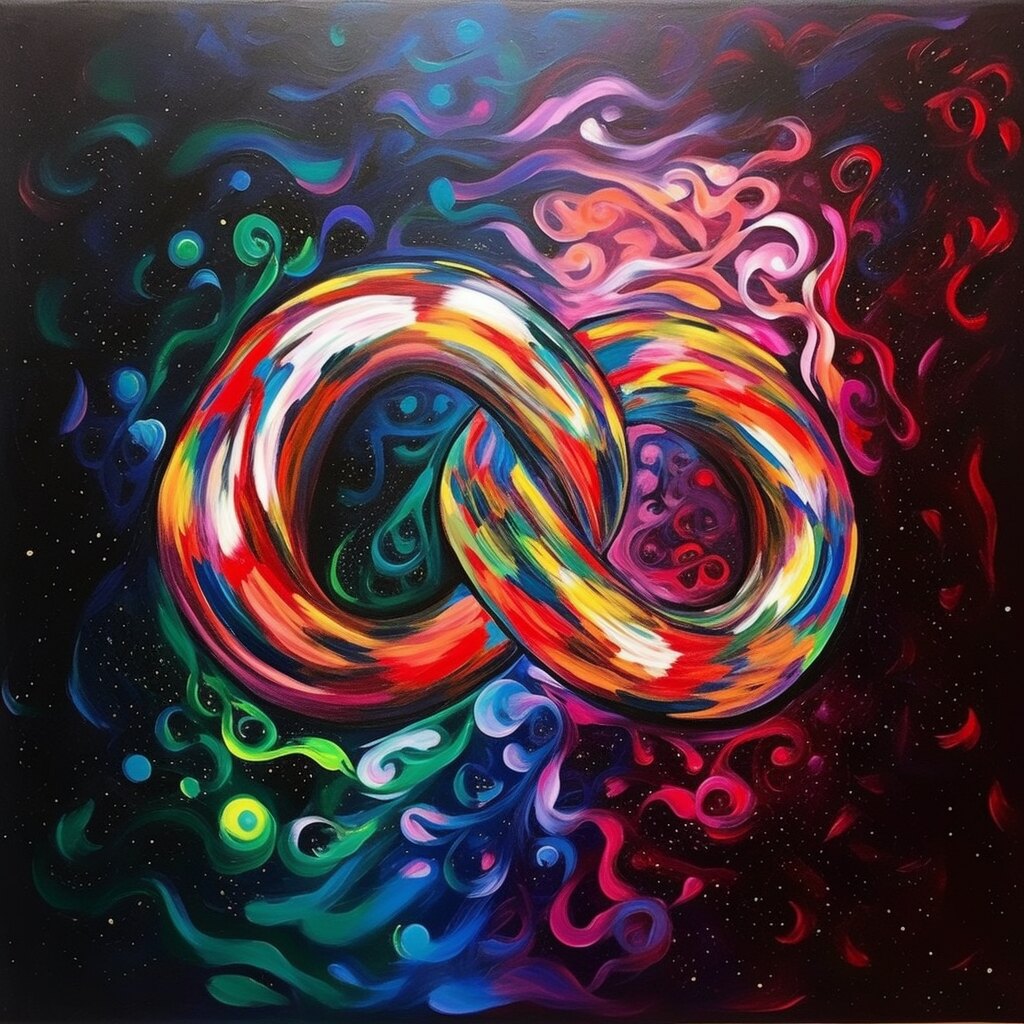
Thousands of years ago, in ancient Egypt and later in Greek alchemy, people drew the ouroboros — a serpent or dragon swallowing its own tail, forming a closed loop. It stood for cycles with no end: death feeding life, endings becoming beginnings. It was not the ∞ we use today, but it carried the same heartbeat — eternal return.

A mathematician gives infinity its sign
The modern symbol arrived in 1655, when the English mathematician John Wallis used ∞ in a work on conic sections. He never fully explained his choice. Some believe he adapted an old Roman way of writing a very large number; others think he was inspired by the Greek letter omega (ω), the last letter — the end beyond which there is no end.

- Antiquity — the ouroboros: eternity as a closed loop.
- ~350 BC — Aristotle separates potential from actual infinity.
- 1655 — John Wallis writes ∞ for the first time.
- 1700s+ — the looping shape gets the name lemniscate, from the Latin for "ribbon."
- 1858 — the Möbius strip: a real object with one side and no end.
- 1870s–80s — Georg Cantor proves some infinities are larger than others.
The ribbon and the one-sided loop
Mathematicians came to call the figure-eight curve the lemniscate, from lemniscus, Latin for a hanging ribbon. Then in 1858 two mathematicians, August Möbius and Johann Listing, described the Möbius strip — take a strip of paper, give it a half-twist, join the ends, and you get a surface with only one side. Run your finger along it and you never reach an edge. Infinity, suddenly, was something you could hold.
For 370 years a single looping line has carried humanity’s oldest wish — that something, somewhere, never ends.∞
From a snake to a ribbon to a twist of paper, the story of the ∞ is really the story of us never quite accepting limits. That refusal has a name now. We call it being an Infinite Soldier. Dive deeper into the great theories of infinity next.

The line keeps going. So do we. ∞